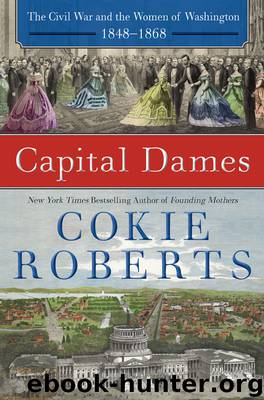
Capital Dames by Cokie Roberts
Author:Cokie Roberts
Language: eng
Format: epub
ISBN: 9780062199287
Publisher: HarperCollins
Published: 2015-03-25T16:00:00+00:00
AFTER THE 1856 campaign, when the first nominee of the Republican Party, the dashing explorer John C. Frémont and his alluring wife Jessie garnered such enthusiastic public attention, the couple had stayed active politically. When the general resigned from the Mountain Department of the army in 1862, miffed at his reassignment to report to General Pope, the Frémonts moved to New York, where they lived in limbo with John still in the army, waiting fruitlessly for another military command. Jessie, no longer as alluring (her former friend Lizzie Lee cattily reported the gossip that “she has grown huge”), wrote a not very veiled defense of her husband’s handling of his command of the army in Missouri. Publishing The Story of the Guard under her own name, Jessie, who had done so much of the writing of her husband’s books, now read reviews describing her effort as “a true woman’s book” with “no style, or a careless and imperfect one.” That was fine with Jessie; the book sold well and she excused her boldness in writing it by saying that the proceeds would go to the families of the fallen Missouri warriors. When she was able to contribute five hundred dollars for the support of the families, Mrs. Frémont told her publisher that in a difficult period, with her husband pining for an army command, the book “has brought to me from so many quarters the most charming evidences of sympathy . . . I am thoroughly gratified by it.”
Jessie had reason to fear criticism. This book about the war wasn’t anything like the fictional stories written by the “literary ladies” of the time, so it was important that the public understand she was acting out of charity. This woman who loved the limelight assured her readers that it had been a sacrifice for her to reveal anything about her life; she asked them “to bear this in mind, and not think this attempt to relieve suffering more unwomanly or less needed than any of the other new positions in which women are finding themselves during this strange phase of our national life. The restraints of ordinary times do not apply now.” Jessie had never paid attention to the “restraints of ordinary times” but she had to suffer them for a while as the family waited uneasily in New York, expecting that any day Frémont would return to the front.
Surrounded by sympathetic abolitionists who questioned Lincoln’s commitment to the antislavery cause, and sycophantic hangers-on who promoted Frémont for president, Jessie held tight to her ambition to occupy the White House. She corresponded with congressmen who made pro-Frémont speeches; she protested against “our own political chiefs,” especially the Blairs, and blamed the sluggish course of the war on the “unfaithful watchmen at Washington.” After Indiana congressman George Julian praised her husband, Jessie hounded Horace Greeley, the publisher of the New York Tribune, until he reprinted the speech.
To like-minded friends Jessie railed against Washington’s refusal to give her husband a command: “The Govt. is simply irresponsible.
Download
This site does not store any files on its server. We only index and link to content provided by other sites. Please contact the content providers to delete copyright contents if any and email us, we'll remove relevant links or contents immediately.
| Africa | Asia |
| Canadian | Europe |
| Holocaust | Latin America |
| Middle East | United States |
Fanny Burney by Claire Harman(26615)
Empire of the Sikhs by Patwant Singh(23093)
Out of India by Michael Foss(16865)
Leonardo da Vinci by Walter Isaacson(13351)
Small Great Things by Jodi Picoult(7167)
The Six Wives Of Henry VIII (WOMEN IN HISTORY) by Fraser Antonia(5523)
The Wind in My Hair by Masih Alinejad(5108)
A Higher Loyalty: Truth, Lies, and Leadership by James Comey(4974)
The Crown by Robert Lacey(4825)
The Lonely City by Olivia Laing(4811)
Millionaire: The Philanderer, Gambler, and Duelist Who Invented Modern Finance by Janet Gleeson(4489)
The Iron Duke by The Iron Duke(4370)
Papillon (English) by Henri Charrière(4281)
Sticky Fingers by Joe Hagan(4210)
Joan of Arc by Mary Gordon(4122)
Alive: The Story of the Andes Survivors by Piers Paul Read(4038)
Stalin by Stephen Kotkin(3975)
Aleister Crowley: The Biography by Tobias Churton(3650)
Ants Among Elephants by Sujatha Gidla(3475)
